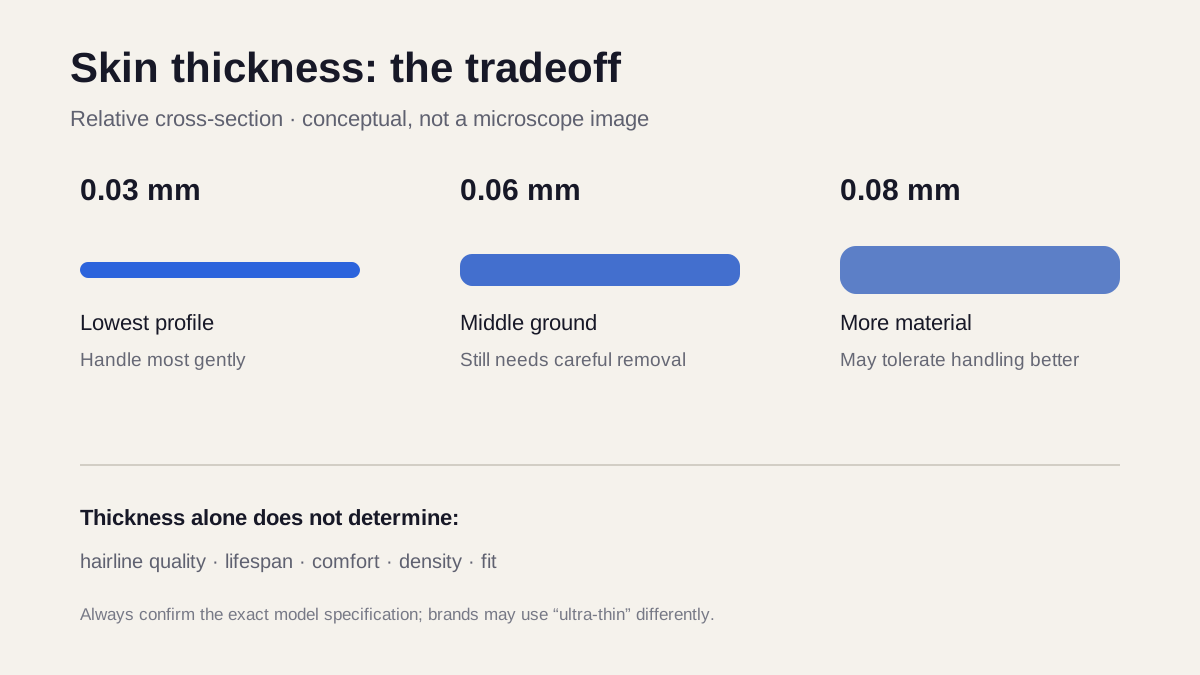
0.03 mm is the most delicate, lowest-profile starting point; 0.06 mm is a practical middle ground; 0.08 mm gives you more material to handle but may be easier to detect at an exposed edge. Exact construction matters more than the label alone.
Side-by-side comparison
| Thickness | Potential advantage | Main tradeoff | Compare it if… |
|---|---|---|---|
| 0.03 mm | Very low-profile skin edge | Least forgiving during removal and cleaning | An exposed hairline matters and you accept delicate handling |
| 0.06 mm | Balance between profile and substance | Still thin; lifespan is not guaranteed | You want a first skin-base comparison without choosing the thinnest option |
| 0.08 mm | More material for routine handling | Edge can be more noticeable in some styles | You usually wear hair forward or prioritize handling over the finest edge |
These are thickness categories, not performance guarantees. Ventilation, density, hairline design, base fit, adhesive and removal technique all affect the result.
Does thinner always look more natural?
No. A thin edge can help at an exposed front, but a natural result also depends on density, color, recession shape, scalp tone, knot or injection method, placement and the cut-in. A 0.03 mm base with an overly dense front can still look less convincing than a slightly thicker base with a better blend.
Does 0.08 mm always last longer?
More material may tolerate handling differently, but thickness alone cannot predict lifespan. Oils, heat, attachment, removal force, cleaning products, sleep and care frequency all matter. Treat any lifespan range as a manufacturer estimate, not a promise.
Choose in three questions
- Will you expose the hairline? If yes, compare the front edge and graduation—not only the listed thickness.
- Will you maintain it yourself? Beginners who remove and clean at home may prefer more forgiveness over the thinnest possible base.
- How often will you replace it? Include replacement frequency in your annual budget with our cost calculator.
“Ultra-thin,” “super thin” and “thin skin” are marketing terms, not universal standards. Confirm the numerical specification for the exact size, color and variant you are buying.
Models to compare
For a 0.04–0.06 mm example, see our LaVivid Upgrade Mirage verdict. For a published 0.06 mm model, compare the Lyrical Hair Ultra-Thin Skin. If airflow matters more than a smooth skin base, compare lace and hybrid constructions.
Common questions
Is 0.03 mm best for a first hair system?
Not automatically. It may suit a careful wearer prioritizing an exposed front, while another beginner may prefer easier handling or a lace base for airflow.
Can I use tape on every skin thickness?
Attachment compatibility varies by model and routine. Follow the supplier’s instructions and test scalp products safely; do not assume one adhesive setup fits every base.
Is skin thickness the same as hair density?
No. Thickness describes the base material; density describes the amount of hair. Use our density guide separately.
Compare the whole system, not one number.
Match thickness with hairline style, density, climate, maintenance and budget.
Compare hair systems →Editorial approach
This guide explains common published thickness categories. The diagram is an editorial schematic drawn to relative thickness, not a microscope image or wear-test result. Product specifications should be reconfirmed before purchase.