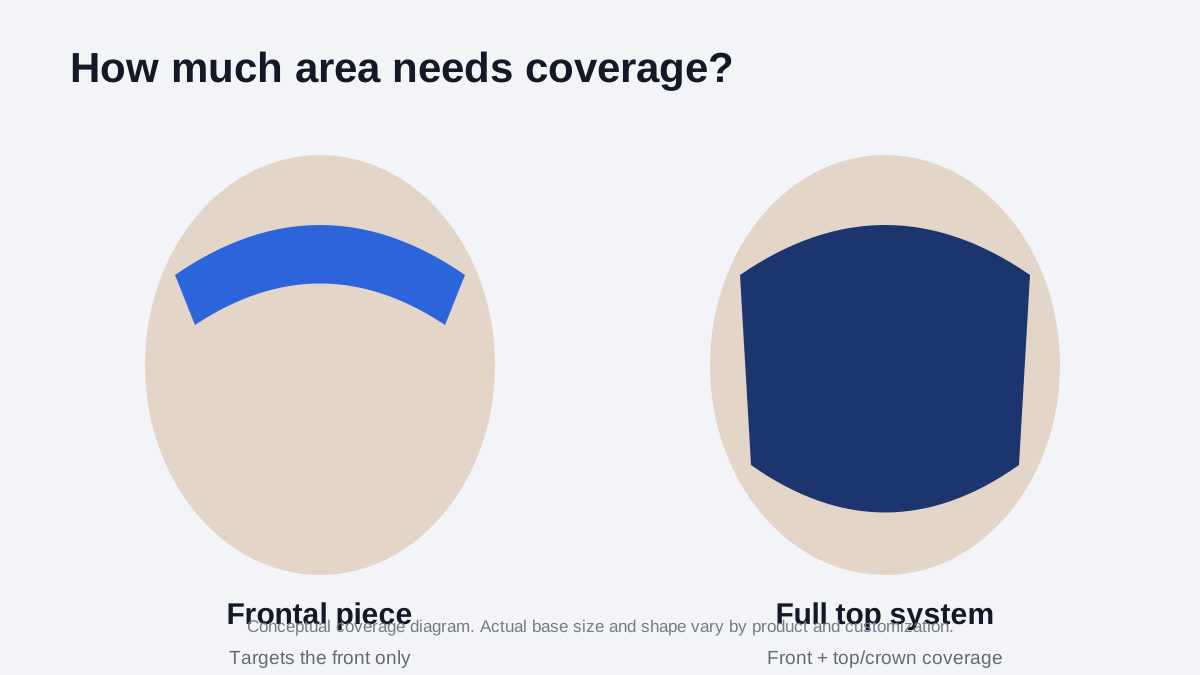
Consider a frontal piece when thinning is limited to the hairline and the hair behind it remains dense enough to blend. Choose a full top system when loss extends through the top or crown, or when the transition behind a frontal would be difficult to hide.
What changes?
| Frontal hairpiece | Full top system | |
|---|---|---|
| Coverage | Hairline/front zone | Front, top and often crown |
| Blend points | Back edge + sides | Perimeter around the top |
| Existing hair needed | Useful density directly behind the piece | Useful side/back hair for the perimeter blend |
| Maintenance area | Smaller | Larger |
| Main risk | Visible transition into thinning hair behind it | More coverage and attachment than you may need |
A frontal may fit when…
- Your recession or thinning is concentrated at the front.
- The hair immediately behind the target area is stable and dense enough to blend.
- You are prepared to match color, texture, direction and density precisely.
- Your stylist can shape the rear edge and haircut around the transition.
A full system may fit when…
- Thinning continues through the mid-scalp or crown.
- You would otherwise be attaching a frontal to weak or rapidly changing hair.
- You want one consistent density and texture across the top.
- Your preferred style makes a rear frontal seam difficult to conceal.
A smaller piece can use less material, but customization, cut-in, attachment and replacement frequency determine the real cost. Ask for an itemized quote for the exact option.
Before ordering
- Photograph the front, top, crown and both sides in daylight.
- Mark the actual thinning area without removing healthy hair prematurely.
- Ask whether the suggested base will overlap growing hair.
- Confirm base dimensions, contour, density, color and curl.
- Arrange the cut-in before the return window or alteration restrictions become a problem.
New to the process? Read how to find a stylist before buying and our pre-cut vs salon cut-in comparison.
Common questions
Is a frontal easier for beginners?
It is smaller, but the blend behind it can be unforgiving. “Smaller” does not automatically mean easier.
Can a frontal cover crown loss?
A frontal is intended for the front. If loss reaches the crown, compare a larger topper or full top system sized for that area.
Will a full system damage my existing hair?
Attachment and removal choices matter. Do not bond over hair or alter the area without product-specific and professional guidance.
Map the coverage before choosing the base.
Then compare density, color and maintenance for that exact area.
Use the hair-system finder →Editorial approach
The coverage image is a conceptual diagram; actual base shapes and dimensions vary. This guide is educational and does not diagnose the cause or progression of hair loss.